
Do wealthy people buy life insurance?

Photo by Jeremy Doorten from FreeImages

The following is my answer to a Quora question: “Do wealthy people buy life insurance?”

Wealthy people buy the most life insurance. It is an irony of sorts that the people who really need life insurance underinvest in it, whereas the people who might have a lesser need overinvest. People of a higher socioeconomic strata have benefited from better financial education. As such, they understand the need to indemnify themselves against loss. They have more to lose.

The difference between the life insurance portfolio of the mass affluent, the high net worth and the ultra-high net worth, beyond the value of their policy portfolio, is in how they structure it. For example, a professional buys life insurance coverage for himself and family, against death, disability and critical illness. He owns the policy no matter who the insured is.

A HNW or UHNW individual has the benefit of a personal tax accountant, personal banker and personal financial advisor. He would likely assign the policy to a company or revocable trust. He is also likely to view insurance policies as another class of financial instruments, and treat them accordingly. For example, he could buy a large single premium life policy that allows him to pay a percentage of that large single premium, and have premium financing arranged that is lower than bank lending rate for a normal loan. This maintains his liquidity, but creates an immediate estate.

That policy is considered fully paid up, and he can take a credit line of up to 105% from his bank with that policy as a collateral. In some circumstances, it can be done up to four times. This means that a possible down payment of less than $20,000 has created a cash flow of several million since it is the size of the policy, not the premium that is the factor.

Insurance also plays a significant role in business succession planning. When a director or executive dies or is disabled, or stricken by terminal illness, creditors may not have as much confidence in the company. They can call back the loan, or refinance it at a higher risk rating. This affects cash flow and leverage. Also, should a major shareholder pass away, his shares revert to his estate or trust. The existing shareholders should have the option of buying out their erstwhile partner without severely crippling the cash flow of the business. In such a case, they use term plans, assigned to the company, with a legal agreement to pay out a certain percentage to the estate of the deceased or first option on the shareholdings. These policies are then put on the books as a benefit to the director in question to mitigate personal income tax.

Insurance policies, managed well, are still the easiest and cheapest way to create an immediate estate. They have many uses, and there are policy types to cover every contingency if you have the money for the premiums.

Terence Kenneth John Nunis

[Shared with permission from: https://terencenunisconsulting.blogspot.com/2020/05/quora-answer-do-wealthy-people-buy-life.html?m=1 ]
Do I have to pay Zakat on wealth in Ramadan?

[Zakat in Practice (part 5)]

[Introduction: This series is a sharing on zakat from the perspective of a financial planner. It is hoped to be educational, informative as well as practical to help readers better understand Zakat, especially Zakat on Wealth, as a Muslim in Singapore.

Topics to include: Zakat on Investment, Zakat on Savings, and Zakat on Estate.]

[Previously: Zakat in Practice (part 4) ]


Do I have to pay zakat on wealth in Ramadan? Not necessarily so.

While Zakat al-Fitr is bound to Ramadan, Zakat on Wealth is bound to:

  • Nisab (“minimum sum”)
  • Haul (holding period of one Hijri year)

Your haul may not fall in Ramadan. Rather, it may fall way before Ramadan, such as your investment financial year ending in December.

Hence, holding your zakat payment (on wealth) till Ramadan would mean you’re either delaying it (which is frowned upon) or paying it in advance (which shouldn’t be the case, as you’ve yet to fulfil the requirement of haul).

However, Dr Haniff Hassan did clarify to me that payment of zakat on wealth is regarded as an obligation that is muwassa’: literally means vast, whereby one can choose to pay it early (or in advance) or later.

(In the continuation of this series, I’ll be focusing more on Zakat on wealth, as this series is in the perspective of a financial planner. Moreover, our asatizah would have covered or be revisiting Zakat al-Fitr in this few weeks to Ramadan.)

(To be continued)

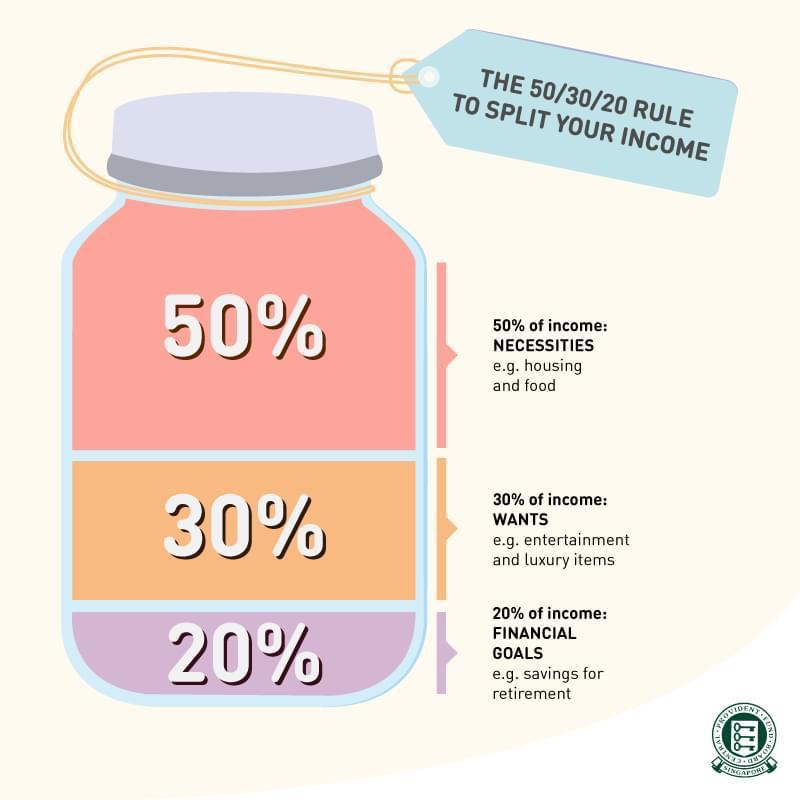
Budgeting your expenses

Quite often, when we mention “budgeting”, we’d often be told to differentiate our needs and our wants.

This 50/30/20 rule reminds us that on top of needs/necessities and wants, we should also set aside a portion of our budget for financial goals.

Personally, I prefer the 4321 rule shared by Alfred Chia (CEO, SingCapital) which he shared in an article in Berita Harian many years ago:

  • 40% Debt repayment
  • 30% Expenses
  • 20% Savings & investments
  • 10% Insurance

I’d translate the above as one should not spend more than 40% of his income on debt repayment and not more than 10% of his income on insurance.

If you are spending more than 40% of your income on debt repayment, you should consider looking into refinancing.

If you are spending more than 10% of your income on insurance, you might be spending more than you should. It would be good to review your insurance portfolio and restructure where appropriate.

I’d often be asked, “Farhan, 30% of income on expenses isn’t much!”

Well, it goes back to your debt repayment. If you have less to pay for debt repayment, you’ll have more for expenses.

“Is 20% of income on savings or investments enough?”

I’d say it is a good start. However, it depends on the size of your income as well as your financial responsibilities and commitments.

You may have to start lower, or you might be able to afford more than 20%.

If you have to start low, do commit yourself to start with 10% of your income. It is after all for your future benefit.

How do commission-based financial advisors help customers without conflict of interest?

The following is my answer to a Quora question: “How do commission-based financial advisors help customers without conflict of interest?”

Within the context of Singapore, there is the balanced scorecard (BSC) framework. A financial advisor must conduct a thorough fact find, and justify any recommendation. There is an annual ethics assessment, market surveys post-transaction checks and mystery shopping. The penalties for running afoul of the BSC are severe, with the very least penalty for an E grade is termination and loss of license.

The Financial Health Review document that is used as a basis for recommendation of a financial product is a comprehensive document, and includes a section on client needs, budget, financial health and existing coverage and investments. This makes it difficult to engage in pure product pushing without doctoring the findings.

Within the conduct of the fact find, the financial advisor is legally compelled to remind the client of their rights, of the risks of certain products, and the limitations of any product. They also sign off on the relevant sections of the document. Since there is a comprehensive mystery shopping exercise, particularly at roadshows, financial advisors have to very diligent about this fact find.

The regulatory framework aside, financial advisors make only one mistake before losing their license. The recruitment and training process is vigorous, and there is a serious effort to ensure that ethics and compliance is a business culture.

Terence Kenneth John Nunis

[Shared with permission from: https://terencenunisconsulting.blogspot.com/2020/04/quora-answer-how-do-commission-based.html?m=1 ]

Is it time to buy or sell your investment?

[This post was originally posted on my FB page on 9 March 2020.]

Timing the market may not be a wise move.

There are at least a few factors to be considered:

  • what’s the purpose/objective of the investment?
  • is it a single sum investment or regular contributing investment (dollar cost averaging)?
  • what sectors are you investing in? Heavy in bonds or equities?

Just as important: what’s your risk profile?

These are the few factors minimally to be considered before you decide to buy or sell, or to hold.

Zakat in Practice (part 4)

[Introduction: This series is a sharing on zakat from the perspective of a financial planner. It is hoped to be educational, informative as well as practical to help readers better understand Zakat, especially Zakat on Wealth, as a Muslim in Singapore.

Topics to include: Zakat on Investment, Zakat on Savings, and Zakat on Estate.]

[Previously: Zakat in Practice (part 3) ]


The recipients or beneficiaries of zakat are 8, as mentioned in the following verse:

“The alms are only for the poor and the needy, and those who collect them, and those whose hearts are to be reconciled, and to free the captives and the debtors, and for the cause of Allah, and (for) the wayfarers; a duty imposed by Allah. Allah is knower, Wise.”

(Quran 9:60)

To put them in a list:

  • the poor
  • the needy
  • the collectors
  • those whose hearts are to be reconciled (mu’allafatu qulubuhum)
  • to free the captives
  • the debtors
  • for the cause of Allah
  • the wayfarers

However, it should be noted that the above 8 beneficiaries apply under Zakat on wealth, not Zakat al-Fitr (which is payable in Ramadan).

For Zakat al-Fitr, the only beneficiaries are 2:

  • the poor
  • the needy

(To be continued)

Zakat in Practice (part 3)

[Introduction: This series is a sharing on zakat from the perspective of a financial planner. It is hoped to be educational, informative as well as practical to help readers better understand Zakat, especially Zakat on Wealth, as a Muslim in Singapore.

Topics to include: Zakat on Investment, Zakat on Savings, and Zakat on Estate.]

[Previously: Zakat in Practice (part 2) ]


Do you know that in many instances in the Quran, zakat is referred by Allah as sadaqat?

إِنَّمَا الصَّدَقٰتُ لِلفُقَراءِ وَالمَسٰكينِ وَالعٰمِلينَ عَلَيها وَالمُؤَلَّفَةِ قُلوبُهُم وَفِى الرِّقابِ وَالغٰرِمينَ وَفى سَبيلِ اللَّهِ وَابنِ السَّبيلِ ۖ فَريضَةً مِنَ اللَّهِ ۗ وَاللَّهُ عَليمٌ حَكيمٌ

The alms are only for the poor and the needy, and those who collect them, and those whose hearts are to be reconciled, and to free the captives and the debtors, and for the cause of Allah, and (for) the wayfarers; a duty imposed by Allah. Allah is knower, Wise.

Quran 9: 60

Although sadaqat is used, it’s not referring to charity in general but zakat specifically.

Hence, sometimes it is said:

Zakat is compulsory charity, Sadaqah is voluntary zakat.”

(To be continued)

No best way to invest

Image courtesy of: Audi MediaCentre

The following is my answer to a Quora question: “Why is there not a best way to invest?”

There is no best way to invest in the same way there is no best car. Some people like road racing, some like off road racing; some like rally racing. Investment strategies depend on the investment horizon, risk tolerance, principal capital, investment objective, and the ambient conditions of the market you invest in, and where your investment vehicle is based.

Aside from all the technicalities of putting money somewhere for a greater potential gain, you have to consider your tax liability wherever you are, political risk and currency exposure which is always relative depending on where you are in the world. That is why people in certain places favour one type of investment or investment strategy over another. A group of people in a different geographic region would have a totally different preference because of this.

For example, Singapore is one of those places with no capital gains tax. It is an entirely different matter in Indonesia. So, Indonesia’s ultra-wealthy tend to invest through vehicles based in Singapore. But there is creative accounting when it comes to declaring gains. These actions are not necessarily illegal, but they skirt the border sometimes.

Terence Kenneth John Nunis

[Shared with permission from: https://terencenunisconsulting.blogspot.com/2020/04/quora-answer-why-is-there-no-best-way.html?m=1 ]

Shariah-compliant Investment and Debt

Recently, I came across a Facebook ad on what makes Shariah-compliant Investment different.

One of the points mentioned is “No debt or interest payments in the investment structure.”

This is a laughable claim as it reflects ignorance of the Facebook page.

Anyone who has been involved in Islamic finance would and should know of Debt to Equity ratio.

1- Debt to equity ratio: The problem with debt in the capital structure of a company, from an Islamic point of view is that it is interest based. A company indebted through Murabaha, for instance, need not have any such restriction. Borrowing on interest is not permitted, therefore it is necessary that such borrowing is limited to a tolerable level. In certain situations Shari’ah treats minute and insignificant amount of non permissibles as negligible having no effect on the permissibility. But what is the cut off-point? There are many indications in Shari’ah which points out to the “one third” as “plenty”, and that anything less than one third is “trifle”. Though such distinction came in a different context, many contemporary Shari’ah scholars thought it relevant and assumed that a debt to equity ratio of less than 1/3 is tolerable. It is extremely important to note that such. criteria will never be suitable for wine production for example. This because, as we mentioned above, hardly any company can do without some debt. Our objective here is, therefore, to measure the extent of the firms financing with debt. Debt to equity ratio represent the relationship between funds supplied by creditors (debt) and investors (equity).

https://islamicmarkets.com/education/equity-screening-in-islamic-finance

Time and time again, we would find people who claim “Shariah-compliant” in promoting their financial or investment planning services, yet they do not know their stuff.

While I personally do not restrict myself to “Shariah-compliant” financial planning and advisory, and preferring what I would call a “practical financial planning for Muslims” approach (I shall write on this in a post soon, Insha Allah), occasionally I would find myself having to call out such claims of “Shariah-compliance” and exposing the claimant’s ignorance of his own field as a financial practitioner or even as someone who claims to do “Shariah-compliant” financial planning and advisory.

As mentioned in my introduction to this blog, I will be writing on a series called “Dispelling myths of Riba” from my perspective as a financial planner and a Shariah student.

Wise advice from a rich person

The following is my answer to a Quora question: “What is the wisest financial advice you have heard from a rich person?”

One of my ultra-high net worth clients once told me, “The banks are not there to make you money; the banks are there to make the banks money.” What this means is that while banks are useful, it is never wise to keep money only in the banks. It is important to diversify assets and financial instruments. And that is why he bought a lot of insurance policies, in addition to his other investments.

In every financial crash, it is banks that collapse, and require bail outs, not the insurance companies – somebody needs to insure the banks. In the 2011 crash, AIG was the only insurer that was in trouble, and it was because of credit swaps, not a weakness in the insurance industry. It is because of the weak US regulatory regime that a major insurer could engage in such a risky practice.

This is the same person who also said, “Poor people have savings accounts. Rich people have investment accounts and current accounts.” This means we should separate our accounts for bills from our accounts for wealth accumulation and management.

Terence Kenneth John Nunis

[Shared with permission from: https://terencenunisconsulting.blogspot.com/2020/04/quora-answer-what-is-wisest-financial.html?m=1 ]

Design a site like this with WordPress.com
Get started